Showing posts with label fish. Show all posts

Friday, 16 May 2014

Catherine our young guest blogger from St Andrews shares her writing

 A description of the journey of an eel.

As I slipped through the waves,their fingers licking me as I went along, the sky gazed down upon me.  The serenity struck me as I entered the river; the dark waters were lifeless and empty.  Weeds embraced me as I danced past, but whether they were capturing or loving me I wasn't sure.  Looking through the beautifully deadly waters, the peace hit me.  At night the waters were cold and merciless, hence my journey taking a long time.  However, the day bought calm and sight.  Rocks encrusted the edge o the river like a crowd of faces, jutting their chins out in search of food.

The dark rivers seemed endless pools, drifting into foreign lands. The water - which was filled with sharp rocks and boundless boulders - was my greatest friend, but also my greatest enemy.  Sharp, invisible nets grasped me desperately writhing body until I fled in the other direction.  My heart built up a nest o f fear after close encounters with shiny cages that stole the air from my lungs; rock walls that blocked my view; and evil-smelling debris piles with little space for me to slither past.  Other eels occasionally appeared in the same same problems as me, some lying on rocks as ghastly white strips, dead.  One day (where the vast expanse of water lay innocently and undisturbed) two golden spikes pierced the surface of the water.  I as knocked into the shimmering waves.

I was being attacked by a heron.

Clusters of weeds snapped helplessly around me, putting up no resistance to the force that was shredding them apart.  The spears collided with my body, heaving it further away from the river.  Dark eyes glinting with malice drew closer...and closer....and closer.  Suddenly, I strained in on pain staking motion and flipped back into the water.  Bubbles zooming like cheering crowds past me, whilst the heron screeched in the distance.  My heart stopped rumbling inside me, and a looming mas of darkness appeared.  Nightfall?  A wall of rocks?  It was none of those things:  it was a flood defence.

I stopped uncertainly, and the gentle splash of disturbed water ricocheted in the waves around me,  As the steep edges of the river laughed at my misfortune, I saw a pipe and had a great idea.  I dragged myself up the pipe, a steep angle into the unknown.  Squinting, I noticed the walls shifting and distorting; I swam closer.  I saw creatures.  Eels!  The river was far away, the walls of the rock distant.  I had tried to persevere, and I don't know where the rest of our journey was taking us.  Would we ever complete the journey?

When I sensed that nightfall was ending, I felt a sharp movement.  It wasn't me.  Sliding away from the other eels into the cold river I understood.  It had been an eel pass.  Free at last!  I swam over the rocks and into the future.  I was nearly at my wonderful new home.

Catherine, year 5 St Andrews

Wednesday, 30 April 2014

Eely exciting times at Wrington and St Andrews primary

Year 6 at Wrington Primary school and Year 5/6 at St Andrews Primary school in
Congresbury were very excited last week to receive their very special guests who are
going to be living with them for the next few weeks - 120 glass eels!


Each class learnt about eel ‘husbandry’ and what to check for every day in the tank to
make sure that the eels are living in a healthy environment, how much food to give them
and how to keep the tank clean.

We then went on to match up pictures to display the eel’s life cycle - its fascinating and
mysterious stages of development - and to make sure we matched the correct terminology
and definitions to describe those stages. Even the correct word for the larval stage which
is ‘leptocephalus’! We also discovered the myriad of problems that eels face throughout
their life cycle - from encountering impassable flood defences on their way upstream to
being eaten by a hungry otter, or even caught by a keen fisherman in a special ‘glass eel
net’.

Then it was outside to try to get some (pretend) elvers from one end of the ‘river’ to the other. This was only possible if the elvers could escape the hungry heron, navigate the
natural boulders in the river, swim against the current and get past the lock gate. Luckily
the majority of them made it which is what we would hope happens in real life.
Unfortunately though, real elvers might find it a lot more difficult to reach the lake where
they can mature into adults and spend most of their adult life stage.


Back inside, we acted out being part of a freshwater food chain and thought about where
an adult eel and a glass eel could be in that food chain. We discovered that it wasn’t
always as simple as it seemed. And to see how food chains turn into food webs we chose
some saltwater food chains to join together to create a saltwater food web.

Next week we will see how the glass eels have progressed - have they become more
pigmented; have they grown; have they formed any interesting habits? We’ll keep you
posted. We’ll also be learning all about the water on our planet and how we have to look
after it.


Sunday, 27 April 2014

Spawn to be Wild

Launching our 'eely' exciting new project - Spawn to be Wild

We are delighted to launch our new schools project kindly funded by Bristol Water.  'Spawn to be Wild' is rearing young eels (elvers) in schools in the Congresbury area, just outside of Bristol, with a whole programme of curriculum based learning activities all based around this fascinating animal.

Children at Yatton Primary School with Jo from Avon Wildlife Trust and Patric from Bristol Water
Children in Yatton Primary, St Andrews Primary and Wrington Primary will all be carefully nurturing their elvers over the next term before releasing them into Blagdon Lake where the eels will live until they return back to sea to spawn.  Whilst their elvers are growing the children will learn all about the fascinating lives of these eels, the challenges they have to overcome to make it up our rivers and into the lakes and what they, and all their classmates, can all do to help save the eel.  
Jo Morris, Learning Development Manager for Avon Wildlife Trust with the box of elvers ready to go in the tank
The first session in school saw students learning about lifecycles and all about the barriers that these elvers have to overcome when they reach our coastlines and try to make it up the rivers, including weirs and locks as well get past hungry predators such as the heron.  Bristol Water have developed ways to help these eels and have made an 'eel pass' at Blagdon Lake where the eels can wriggle up to get over the dam wall in a bid to help these wonderful fish and the students will get to see this when they go to release their eels.
Students at Yatton Primary playing the eel challenge game

The European eel has a fascinating life-cycle; it is a catadromous species, breeding in the sea and migrating to freshwater in order to grow before returning to the sea to spawn. It is thought that all European eels spawn in the Sargasso Sea which is near Bermuda. The larvae, which look like curled leaves and are known as 'leptocephalli', drift in the plankton for up to three years, and are carried by the Atlantic currents towards our coastline. They then undergo metamorphosis into young eels; at this stage they are known as 'glass eels' because they are transparent. They become darker in colour and start to migrate up freshwater streams in large numbers; they are known as 'elvers' at this time. The eels, now called 'yellow eels' grow in freshwater spending up to 20 years in freshwater. Towards the end of this time, they become sexually mature; they turn a silvery colour and migrate back towards the sea on dark, moonless and stormy nights; during this time they are known as 'silver eels'. Upon returning to the sea, the European eel lives in mud, crevices, and under stones but no one has ever seen or recorded how these fish reproduce or where exactly.   

So the elvers in the schools tanks, that were provided by the Severn and Wye Smokery and UK Glass eels, have already had the most adventurous three years of life and eels can live up to a whopping 85 years - lets hope the elvers that are in schools now reach that grand old age.

Watch this space for more eely exciting news as Spawn to be Wild continues.

Friday, 14 February 2014

Introducing our fantastic guest blogger for this week, Rocco, year 5 from Windwhistle Primary School - take it away Rocco!


Yippee!  Only one or two more eggs have to hatch!  I'm not quite sure how long it took but that day was amazing.  
They are all swimming really swiftly but they are certainly much quicker than I expected.  They look like they have no idea where they are.  I named 3, one Larry, one Nev  and one Kendrick.

I think they have become more interesting as they grow and many more people want to have a look now since they all have hatched into alevins.

I'm not sure what we will feed them but at the fish farm it was brown and cylinder shaped food, they jump up and catch it either to show off their goal keeping skills or to show they are hungry.

Anna from Avon Wildlife Trust hasn't seen them all hatched yet but the last time she came in two were alevins but they were not moving - probably sleeping on their yolk sacs.  I almost forgot to tell you Kendrick and Larry have got to the bottom of the tank - Larry did it first and that's why I called him Larry Loner.  They are deep sleepers - the only thing they do is a wriggle or their way of doing Gangnam style.  I think they have already done about 75 laps around the tank!

 
 Rocco year 5, Windwhistle Primary


Here are the rest of Rocco's class learning all about sustainability and how long it takes for waste to decompose in the oceans.

Thank you Rocco, a fantastic blog and we can't wait to hear about how all the other alevins and their names!


Friday, 24 May 2013

Nature is full of surprises...

Over the last two years I've been working with local schools in Southmead, Bristol, taking students on visits to the local nature reserve, Badock's Wood. Throughout the seasons students have explored the woodlands, wildflower meadows and hedgerows discovering an abundance of wildlife living in their neighbourhood.

 This project has been kindly supported by the Airbus Corporate Foundation to engage young people with the biodiversity in their area and as part of this project a new wildlife pond was created last year. Unfortunately, the pond suffered a fair bit of vandalism as soon as it was created, with benches being pulled out of the ground, plants ripped up and rubbish thrown in the water. Nevertheless, students from surrounding schools have been learning about freshwater life and went to look at the pond at every opportunity.

Last week was the first opportunity the pupils had to properly explore the pond, so we set off with nets, trays, identification keys, bug jars and a belly full of enthusiasm. Having visited the site a few days previously I was a little skeptical as to what we would find.The pond was brown with mud, there were no plants and I could see that someone had already added fish in the water which is never good news if you are looking to create a biodiverse pond as they devour the invertebrates, tadpoles, and anything else they can find.

After a health and safety briefing and a quick chat about how to use the equipment, students eagerly started to explore. Working in groups they took turns to take samples from the pond, emptying their findings into trays so that they could identify the species.

One of the first species to be found was a Greater Water boatmen. These strong swimmers swim on their back using their strong legs, which are covered in tiny hairs, to propel themselves through the water. All aquatic bugs lack gills and therefore have to come to the water’s surface to breathe air. However, Water boatmen have a clever trick that allows them to remain under water for longer. They collect air as a bubble on their body or under their wings; this allows them to breathe when underwater. When we looked carefully, using a bug jar full of water, we could see the little silver bubble at the end of it's abdomen as it dived down.
Common backswimmer - Mark Robinson - Mark Robinson

Male Water boatmen breed once a year and  use sound to attract females by rubbing their front legs against a ridge on their head to create a low chirping noise. Females lay their eggs on submerged plants, sticks, or rocks; allowing a brood of young Water boatman to hatch out straight into the water.


Pond skater - northeastwildlife.co.uk - northeastwildlife.co.uk
We also discovered pond skaters. These seemingly relaxed looking creatures, live on the surface of the water, spreading their long legs out and using the water tension to keep them afloat. But don't be fooled, really they are waiting for the chance to snack on dead or dying insects that have fallen into the water.They have sensitive hairs on their  bodies and legs to detect vibrations and ripples on the pond surface and using their sharp mouth parts they pierce the skin of their prey and then suck out their insides.
Most excitingly, we found a pair of breeding palmate newts. Male palmate newts can be identified by their large, black, webbed feet.They are darker in colour than the females who tend to be a more olive-green colour. Newts are amphibians and they enter the pond in the Spring to mate. The males swim around in an elaborate dance to attract the females who wrap each of their eggs individually in vegetation around the pond. At the end of the summer, adult newts will leave the pond and find a suitable home under some stones or logs perhaps,feeding off small invertebrates such as beetles. We were very surprised and pleased to discover them living in the pond at Badock's Wood nature reserve.
Pair of palmate newts
Male palmate newt
In addition to the fish, newts, Greater water boatman and pond skaters we found some tadpoles, diving beetles, great pond snails and water fleas so there was life in the pond after all! One of the main problems in this pond is the lack of plants and the muddy water. This is quite possibly due to dogs running in and out of the pond and stirring up the sediment - the lack of light reaching into the water impacts on the ability of the plants to grow. The students are now being very proactive about this and the school is running a poster competition to let people in the wider community know why it is important to protect this potentially great habitat. So fingers crossed, this time next year it could be a different story.

After the pond dipping we went down to the River Trym which flows through the nature reserve. Using this as a comparison to the pond we discovered that it was much more abundant in species. Biological indicators such as freshwater shrimps and mayfly larvae also suggested that it was a pretty healthy habitat too.With the newly informed wildlife explorers from Badock's Wood primary school on the case I feel pretty confident that the nature reserve will continue to go from strength to strength.
Stream dipping in the River Trym


Tuesday, 19 March 2013

Free the fish!

Last week many of the classes involved in the Trout and About project visited Blagdon and Chew Valley lakes and set their fish free.At Blagdon lake students had the opportunity to feed some really big fish and see some fry that were slightly older than the fish they had raised in school.
Feeding the fish at Blagdon visitors centre

Looking at the fry


Releasing the trout at Chew Valley Lake
Here's an extract from class 5B at Ashton gate primary school


Goodbye Trout!

On Monday we went to release our trout (fry) into a real water habitat.
We all went on mini buses to get to Blagdon, where the Bristol Water Company set up all their machinery. They showed us many different things, including lot’s of tiny little trout, massive trout feeding and powerful machines for purifying water. After this, we got back on the mini buses and set off to Chew Valley Lake, where we would release the trout. We were each given sticky bits of paper to stick natural resources on to make a picture. After that, we set of on the long journey to the lake. When we got there we were releasing around 8 fry in partners into the further upstream lake. We waved them off and wished them luck in the big wide world! Then we walked to bird hide where we given binoculars in pairs to spot some beautiful nature. Although it was freezing, we were all had a lot of fun!

So far I think we must of released over 500 trout! The last field trip is tomorrow with Parson Street primary. I'm going to release my fry from the Avon Wildlife Trust office too.

Thursday, 21 February 2013

Today's guest bloggers are....

Oakley, Eve and Amy  (Year 5). They've been updating me on all that's happening at  Ashton Gate Primary school in Bristol.

Wednesday 20th February 2013
The trout, eggs eyes are a little bigger than yesterday and we have had a few visitors that came and had a look. One of the eggs look a bit white but the rest are fine. But we are not sure if we should take it out so we’ve left it in the fish tank.
By Oakley

Thursday 21st February 2013 - morning
The trout eggs have had another visitor this morning. Each day they are getting a little bit bigger. Every day after break and lunch every one gathers around the tank to look at the eggs. As you can guess we are all very excited about the fish.
By Eve

Thursday 21st February 2013 - afternoon

Sadly 3 of are eggs died today. They were found this morning. But it did not stop the attraction. 5B came up this afternoon to look at the trout eggs and at chess club everyone was really interested in the eggs and some people were so interested they did not want to play chess so they could look at the trout eggs especially the fallen one which we named Janes Pond!!! 
By Amy

This week I've also been to Parson Street primary school and South Street primary school in Bedminster. I've given assemblies, explaining the project to all the pupils in each school and encouraging students to think about freshwater and saltwater habitats. In each assembly I have shown this wonderful short film from the One World One Ocean which celebrates the wonders of our ocean with stunning facts about the connectivity of water on our planet.


I've also met some great students, all of whom are very enthusiastic about looking after their trout eggs. I took in my new friend, the yet-to- be-named, big trout caught in 1932 at Blagdon lake,


and discovered some fabulous artists!


Wednesday, 23 January 2013

The eggs have hatched!


The trial for Trout and About continues to go from strength to strength. The fry are getting bigger and stronger and this morning I entered the office to discover the first of our eggs had hatched and the alevin are feeding off the yolk sacs.There have been a few eggs that haven't made it - these are white and opaque so they need to be removed from the tank in order to maintain the hygiene of the general tank conditions, but this is to be expected and the survivors look strong and healthy.


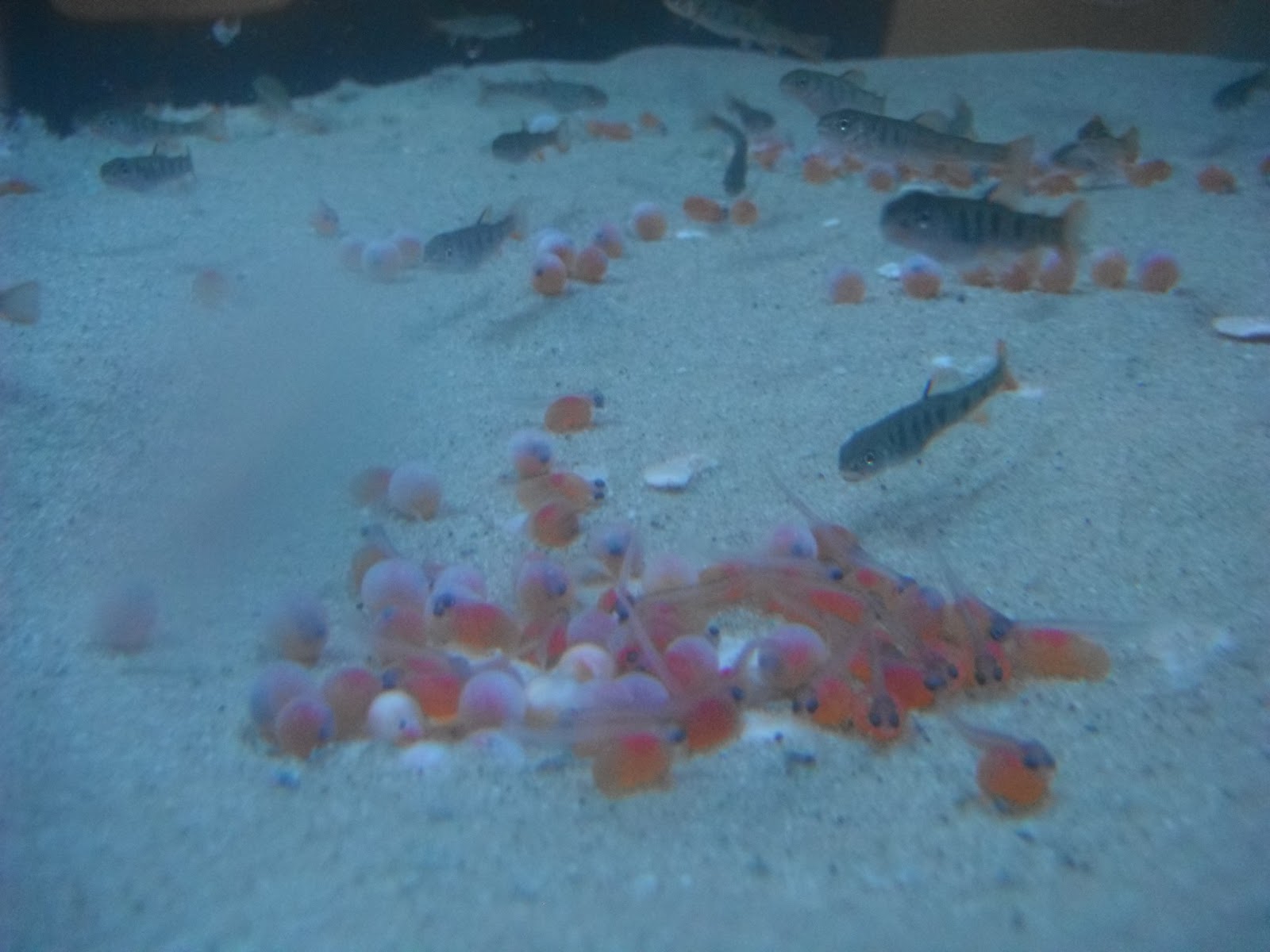
You can see the black eyes of the alevin in the photo. They will stay at the bottom of the tank for a while now, feeding off the protein in their yolk sacs. Of course, in the wild, they would be camouflaged amongst the gravel of the river bed, keeping safe from predators. It's brilliant being able to watch this transition from egg to fish close up, something that would be almost impossible to come across in the wild. Luckily, thanks to the wonders of technology, I found this wonderful video online which shows this this transformation happening in fantastic detail. You can watch it here. It's part of a blog from the Trout in the Town project for urban river restoration from the Wild Trout Trust

Taken from Paul Gaskell's Trout in the Town blog (see above)


In a few weeks I will be putting tanks into school classrooms across Bristol. I really hope that the trout will inspire young people to think about their local rivers, streams and lakes differently and encourage them to protect and explore their local natural environment.

Wednesday, 9 January 2013

We're going Trout and About!

After much anticipation, this week saw the arrival of some new wildlife to the offices at Avon Wildlife Trust. As part of the new 'Trout and About' learning project, starting in schools mid February, I will be rearing trout in the foyer at our Jacobs Wells Road office.

Fry and eggs ready for their temporary new home
Much planning, tank designing and learning about trout has been happening over the last few months and, finally, the tank arrived and Tony Donnelly from Bristol Water, brought in his little tub of fish eggs and fry to put in their new home. 
Navigating around staff who were having their lunch and looking on very bemused, we filled the tank and checked the chiller, flow and filter were all working correctly. We then introduced  the fish eggs and fry which by this point, in an office of Wildlife Trust staff, had became quite a talking point. 
Filling the tank

So, it all started off well but when I arrived the next morning I discovered a few fatalities. In the natural world this is inevitable, in fact 95% of trout don't make it passed the age of 1 in the wild but this was an artificial environment designed to facilitate the development of the eggs in the most productive way. A quick check of the cooler system told me why. With the cupboard doors below the tank closed there wasn't enough airflow and the chiller wasn't working effectively. This rise in temperature, in addition to the change of water and transportation of the fish was too much. Note to self, make some alterations to the chiller cabinet to allow better airflow. All is not lost, we live and learn and we are still having a better survival rate than in the wild. 


In they go!
The Trout and About project has been kindly funded by Bristol Water as part of their catchment management work to improve water courses in the area and supports Avon Wildlife Trust's learning strategy by providing hands on learning opportunities to link schools with their local natural environment. Schools in Bristol will have tanks in their classrooms and will rear trout from eggs over a four week period. 

This is a fantastic opportunity to provide real, memorable learning experiences to support teaching across the KS2 curriculum, whilst allowing schools to participate in a local, conservation project. During the project pupils will visit a local water course to learn about the ecology of rivers. This will provide a connection with their local natural environment, making the project more relevant to their own lives and neighbourhood, whilst providing hands-on learning experiences. At the end of the project pupils will be invited on a field trip where they will be able to release their young trout, visit the hatchery at Blagdon and explore the associated wildlife around the lake. 

Before it gets to the schools though I will be trialing the project myself, so follow my progress on this blog and see how I get on.