Showing posts with label wildschools. Show all posts

Friday, 21 February 2014

Trouttastic titles

We're delighted to hear that the alevins are all doing well over half term in the Weston-Super-Mare schools and the classes have now got to know them well and have even given them names.  Here are some of our favourites so far from two of the schools who have all of their alevins hatched:

from Milton Park Primary School:

Prince William
Alfie the Alevin
Bob
Theodore
Tim (the trout)
Garner
James Daredevil

from Bournville Primary School:

Salem
 Ted
Nile
Miranda
Thammy
Eyessac
Par
Jubilee
Buck
Ben

and from the Avon Wildlife Trust office we have:

Sharon Davis
Shackleton
Fishy (we struggled with that one!!)
Duncan Goodhew

We only have four alevins at the moment so we hope to get more creative as the alevins join us.

There are a lot more alevins in the tank for every school and in the office - can you help us out with any great names?

Wednesday, 23 October 2013

Spawn to be wild - eels in the rivers and streams of the south west

Many species that we know and love here in the South West can claim to have interesting and complicated life cycles, but none are quite as mysterious as that of the European eel (Anguilla Anguilla). They are in fact a type of catadromous fish – that is, they migrate from fresh water into the sea to spawn. For centuries the eel’s life history was not understood, even amongst the many fishermen who regularly caught both the larvae and the more mature stages without realising that they were related. Then in the early 1900s a Danish researcher concluded that the Sargasso Sea, in the western Atlantic near the Bahamas, was the most likely spawning ground and that the larvae slowly drift towards Europe on the Gulf Stream. We now know that after a journey of a year or more, the larvae metamorphose into transparent "glass eels", enter estuaries and start migrating upstream. After entering fresh water, the glass eels metamorphose into elvers, miniature versions of the adult eels. And this is where the trouble begins. Sluices, weirs, flood defences – these all seriously hamper the eel’s migration upstream to a suitable site where they can mature and grow, sometimes to as much as a metre in length in a mature female - before they begin their migration back to the Sargasso Sea to spawn.

Sadly the European eel is now endangered, but the good news is that Bristol Water and the Environment Agency have come up with a solution to help the eels’ migration upstream. Eel passes, that look a bit like a large upside down brush, allow the elvers to navigate up through weirs to a specially designed trap, the first of which has been operational at Bristol Water’s Blagdon pumping station for a few months now. This captures the elvers every night so that they can be safely released into the lake the next morning. Children from Ubley Primary School joined us to launch a fantastic new project which will help raise awareness of this strangely charismatic creature. We are also delighted to announce that four schools in the Congresbury Yeo river area will have the opportunity to rear young elvers in a tank in their classroom for several weeks whilst learning about the local water courses and how they can help to protect them for wildlife, before making the trip to Chew Valley or Blagdon lakes to release them. Who knows, in 20 years’ time their children might be watching the offspring of these elvers as they arrive here after their very long journey all the way across the Atlantic Ocean!
Cathy Mayne


Friday, 22 March 2013

It's World Water Day!


So let's celebrate with this final blog entry about the Trout and About project from 5P at Ashton Gate primary school.

Monday 18 March 2013
Today we went to Blagdon lake and fed 18,000 fish. Then we went on a nature trail through the woods and saw the lake overflow in action. After that we went to Chew Valley lake and walked on a very muddy path to release our trout at the stage of fry. Also we got sticky bits of card and made pictures out of small plants. Some fish had no egg yolk left when we released them. Everyone misses the trout a lot already.


The field trips have been a great ending to a fabulous project. Students have had the chance to see how their fish will grow and develop. They've got muddy and wet, visited small rivers and big lakes, learnt about where their water comes from and how the lakes support a wide range of wildlife. 

Thanks also to Bristol  Water who have funded the whole project, providing the transport and tuition costs, fish husbandry expertise and tanks, which has enabled the project to be truly inclusive. 


Finally,thanks to all the students, your blog entries have been really interesting. I've loved working on this project and glad that you have enjoyed it too. Don't forget to look for the MSC tick when buying fish to make sure it's sustainable and look after your school pond by providing lots of nice plants and keeping it litter free.

Happy World Water Day!

Tuesday, 19 March 2013

Free the fish!

Last week many of the classes involved in the Trout and About project visited Blagdon and Chew Valley lakes and set their fish free.At Blagdon lake students had the opportunity to feed some really big fish and see some fry that were slightly older than the fish they had raised in school.
Feeding the fish at Blagdon visitors centre

Looking at the fry


Releasing the trout at Chew Valley Lake
Here's an extract from class 5B at Ashton gate primary school


Goodbye Trout!

On Monday we went to release our trout (fry) into a real water habitat.
We all went on mini buses to get to Blagdon, where the Bristol Water Company set up all their machinery. They showed us many different things, including lot’s of tiny little trout, massive trout feeding and powerful machines for purifying water. After this, we got back on the mini buses and set off to Chew Valley Lake, where we would release the trout. We were each given sticky bits of paper to stick natural resources on to make a picture. After that, we set of on the long journey to the lake. When we got there we were releasing around 8 fry in partners into the further upstream lake. We waved them off and wished them luck in the big wide world! Then we walked to bird hide where we given binoculars in pairs to spot some beautiful nature. Although it was freezing, we were all had a lot of fun!

So far I think we must of released over 500 trout! The last field trip is tomorrow with Parson Street primary. I'm going to release my fry from the Avon Wildlife Trust office too.

Sunday, 10 March 2013

End of week 3 of #troutandabout

Exciting times.....all the eggs have hatched and my student parents are doing a fine job. The alevins are wriggling around, and as far as I know, Jane's Pond is still alive at Ashton Gate primary and Alevin and the fishmunks are doing swimmingly at St Barnabus.

Hatched alevins at Ashton Gate
This week pupils have been learning about the Marine Stewardship Council and discovering more sustainable ways of fishing and watching their own  fish change and grow as they start to explore the tank.They also discovered that their trips next week will take them to the reservoirs of Chew Valley where they will learn about the different habitats around the lake and compare the freshwater habitat to the one they studied near to their school. These are owned by Bristol Water and supply water to homes, schools and businesses in Bristol. 

Barni from Ashton Gate primary school  has sent an update for the blog.

Thursday 7 March 2013
Julie set the trout out of the cage into the fish tank, sadly a few will never be able to swim because they didn't make it. There's been a few that have tried to swim up but they need to absorb their egg sacks before they can properly swim about.
The trout are huddled together to not be seen. It looks like we will have a few swimmers in a few days.

Two weeks to go......we're hoping to make a film of the project so watch this space to see how the trout and the pupils get on.

Thursday, 7 March 2013

Students get rapping...

This week as part of the Trout and About project students have been learning about the water cycle, water use, marine habitats and how they can contribute to a better environment. They learnt about how the water gets to their taps and what they should and shouldn't put down their toilet! Inspired by Wessex Water's fantastic rap  pupils had a go at writing their own. Here's a flavour...


The Water Cycle
Water goes up...EVAPORATION
A cloud appears...CONDENSATION
Water goes down..PRECIPITATION
Water gets together. That's COLLECTION
Then it starts again

It gets collected in a reservior
Then the water travels far
It travels far
into your car


Water goes up...EVAPORATION
A cloud appears...CONDENSATION
Water goes down..PRECIPITATION
Water gets together. That's COLLECTION
Then it starts again

Use your water well
It's the essential thing so use it well.
Take a shower instead of a bath
If you don't, it's not a laugh


Water goes up...EVAPORATION
A cloud appears...CONDENSATION
Water goes down..PRECIPITATION
Water gets together. That's COLLECTION
Then it starts again

By William and Felix


Just Save Water
Just save water
Just save water
I'm going to say it one more time
Just save water!

Take one less minute in the shower
You don't need to take an hour!

Just save water
Just save water
I'm going to say it one more time
Just save water!

By Barni and Caelan

Just turn off the tap
When you're doing your teeth
Just to go to sleep
Turn off the tap
Before you take that nap

Don't drop your phone in the loo
While you're doing a poo
Cos you don't need an app
Just turn off the tap

By Bradley and Katie

Fabulous! More to come....


Tuesday, 26 February 2013

Look at these beasts....


Close up of a freshwater louse
Miss Barnes year 5 class at Ashton Gate primary have also sent contributions to the blog so I'm going to let them tell you all about their pond dipping experience yesterday.

Damselfly nymph
'We have been lucky enough to do this project trout and about with Julie who is from The Avon Wildlife Trust. We are not the only school doing this, many others are too. Over the past few weeks, we have been keeping trout eggs in the other classroom which we visit regularly. Just recently a few of the eggs hatched into aleviens which is the first stage of a fish’s life. Some of our eggs haven’t survived. Once the eggs die they turn from bright orange to white and opaque. We must remove once this happens as not to infect healthy eggs. The eggs are not supposed to all survive so we are not too disappointed or upset.
Midge larva also known as a bloodworm
Yesterday we went pond-dipping in our school pond to find out more about the wildlife in our environment. We found many interesting things like newts and leeches. We were in small groups and we had a microscope each to study these fine creatures. When we looked at them close up we could see fine detail that defies the eye. We took several indoors so we could all take a very close look. We saw a freshwater louse, a rather sickening blood worm and a damselfly in a shield of leaves and mud to protect it from hungry carnivores. We all found them very fascinating (though some of us with weaker stomach felt a bit sick!) and wanted to still study them the next day.
On the last week of our project we will take a bus down to Chew Valley Lake to release our fully-grown trout. We will wish them much luck with the rest of their life.'


Wow! Great news....


Ashton Gate primary school have sent further updates on their Trout and About project. Things are starting to happen in the cool waters of the classroom fishtank........

Monday 23rd February 2013

Sadly more trout eggs died. Julie came and worked with us and we went pond dipping! We found an egg right at the bottom of the fish tank, and we were all surprised. When we went pond dipping we found Back Swimmers, Fresh water shrimps and even more! It was cool and we had fun!
Barni

Tuesday 26th February 2013

We have really, really good news! Today, when we looked in the tank, we found two alevins! But sadly even more eggs died. The eggs are so famous now they’ve been in the paper! 5B came to visit the trout eggs and were very excited when they realised that two had hatched. Our alevins have been hiding with the eggs in the hope that we haven’t noticed them but, of course, we have definitely noticed them. James Pond is still alive and all we can do is hope that the rest will make it. 
Steph

See if you can spot the alevins below!


This morning I noticed that we had some alevins too at the Avon Wildlife Trust office. I think I was as excited as the students at Ashton Gate primary school! Yesterday when we explored the school pond at Ashton Gate we found a male smooth newt looking rather splendid with his full crest along his back and tail. Students logged key biological indicators to assess if the pond was healthy or not. Some found it to be quite healthy and some found it to be very healthy which was a very good sign considering it's still February.

Tomorrow I'm off to Parson Street primary school to investigate a local stream with Year 5 students. Here's hoping it's a nice sunny day!
I've also posted some amazing drawings on our Flickr account that pupils from parson Street did last week. Take a look and see if you can recognise the key adaptations that help trout to live in a freshwater habitat.

Thursday, 21 February 2013

Today's guest bloggers are....

Oakley, Eve and Amy  (Year 5). They've been updating me on all that's happening at  Ashton Gate Primary school in Bristol.

Wednesday 20th February 2013
The trout, eggs eyes are a little bigger than yesterday and we have had a few visitors that came and had a look. One of the eggs look a bit white but the rest are fine. But we are not sure if we should take it out so we’ve left it in the fish tank.
By Oakley

Thursday 21st February 2013 - morning
The trout eggs have had another visitor this morning. Each day they are getting a little bit bigger. Every day after break and lunch every one gathers around the tank to look at the eggs. As you can guess we are all very excited about the fish.
By Eve

Thursday 21st February 2013 - afternoon

Sadly 3 of are eggs died today. They were found this morning. But it did not stop the attraction. 5B came up this afternoon to look at the trout eggs and at chess club everyone was really interested in the eggs and some people were so interested they did not want to play chess so they could look at the trout eggs especially the fallen one which we named Janes Pond!!! 
By Amy

This week I've also been to Parson Street primary school and South Street primary school in Bedminster. I've given assemblies, explaining the project to all the pupils in each school and encouraging students to think about freshwater and saltwater habitats. In each assembly I have shown this wonderful short film from the One World One Ocean which celebrates the wonders of our ocean with stunning facts about the connectivity of water on our planet.


I've also met some great students, all of whom are very enthusiastic about looking after their trout eggs. I took in my new friend, the yet-to- be-named, big trout caught in 1932 at Blagdon lake,


and discovered some fabulous artists!


Tuesday, 19 February 2013

Guest blog from Anna Year 5

Today's guest blog is from Anna in year 5 at Ashton Gate Primary School, day 2 of their Trout and About project!


trout and about


On Monday Year 5 found out that their new project is on fish. Just to make it more exciting we can watch the life of living fish right in our classroom.
Monday 19th February 2013
Everybody is really excited because we are getting rainbow trout Juiley (a member of the Avon wildlife trust) is helping us to learn about fish e.g. their habitat. We have a big fish tank in 5P’s classroom with a lot of fish eggs in so we are to watch these eggs grow up into big rainbow trout. Once they have grown up we will let them go in Chew valley lake.


Thanks Anna! I'm looking forward to hearing how you get on.

Trout arrive at Ashton Gate primary!


Yesterday was a very exciting day as the first of our schools received their trout. Ashton Gate primary school in Bristol are now the keen parents of lots of little orange eggs. During the day, students learnt how to look after the new additions to their classroom and all about the trout life cycle. They drew some amazing pictures and created their own freshwater life cycles. Each week pupils are going to take turns to write guest blogs and update us all on what's happening so watch this space.....

Wednesday, 23 January 2013

The eggs have hatched!


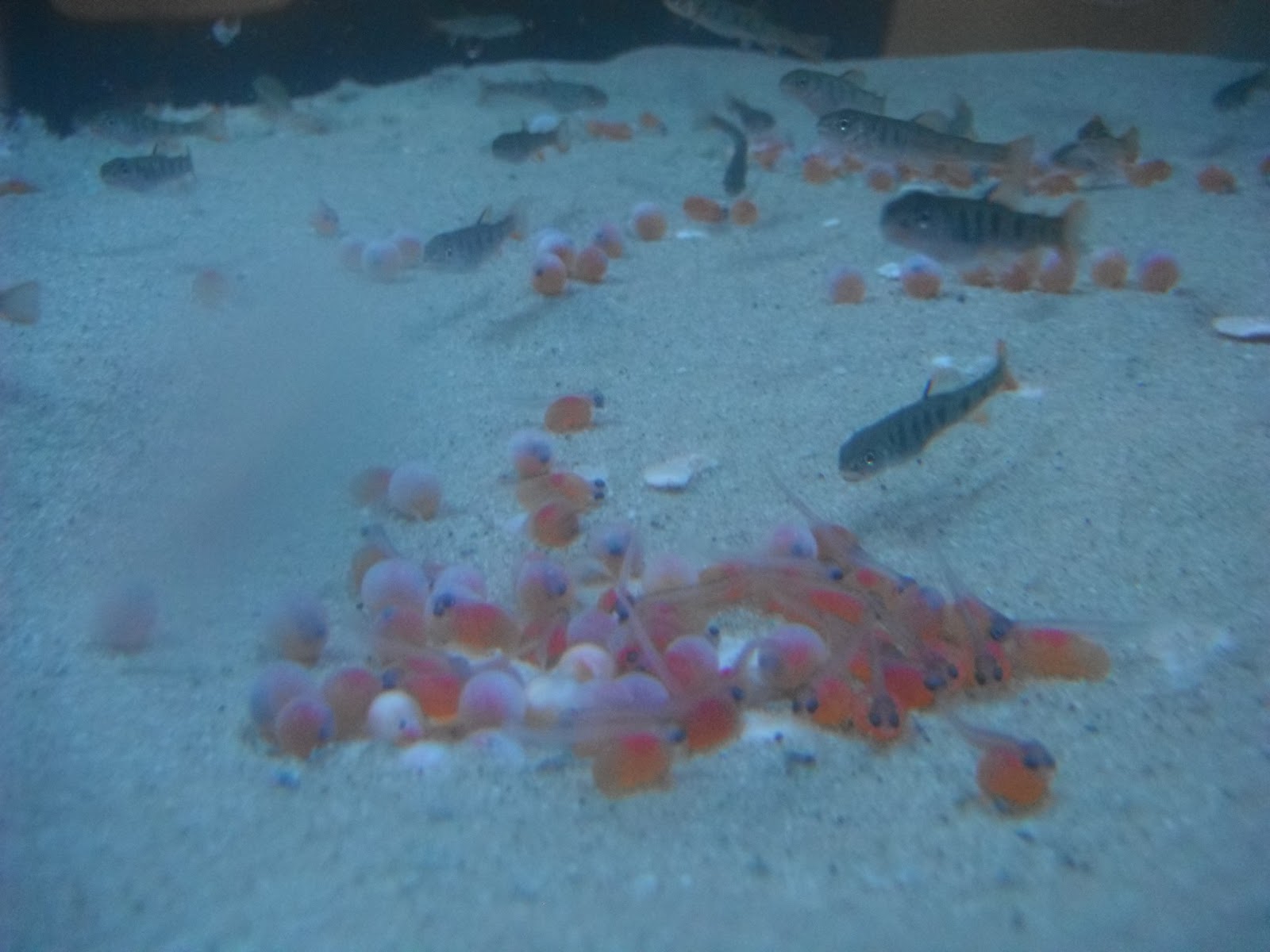
The trial for Trout and About continues to go from strength to strength. The fry are getting bigger and stronger and this morning I entered the office to discover the first of our eggs had hatched and the alevin are feeding off the yolk sacs.There have been a few eggs that haven't made it - these are white and opaque so they need to be removed from the tank in order to maintain the hygiene of the general tank conditions, but this is to be expected and the survivors look strong and healthy.


You can see the black eyes of the alevin in the photo. They will stay at the bottom of the tank for a while now, feeding off the protein in their yolk sacs. Of course, in the wild, they would be camouflaged amongst the gravel of the river bed, keeping safe from predators. It's brilliant being able to watch this transition from egg to fish close up, something that would be almost impossible to come across in the wild. Luckily, thanks to the wonders of technology, I found this wonderful video online which shows this this transformation happening in fantastic detail. You can watch it here. It's part of a blog from the Trout in the Town project for urban river restoration from the Wild Trout Trust

Taken from Paul Gaskell's Trout in the Town blog (see above)


In a few weeks I will be putting tanks into school classrooms across Bristol. I really hope that the trout will inspire young people to think about their local rivers, streams and lakes differently and encourage them to protect and explore their local natural environment.

Monday, 21 January 2013

The trout are thriving....


So far, so good! The fry seem to be enjoying their new home and the eggs are due to hatch any day. Recently, my colleague, Jo Morris, had an exciting 
parcel arrive in the post..... an underwater camera that she was planning to trial for her new Wild Schools filming project. Of course this was a prime opportunity to see what life was like as a trout living at the AWT headquarters. So we tentatively tested it, plunging it into the cool waters of the tank. To our surprise, there was a smooth transition as the camera filmed both inside and outside of the tank, and the fish seemed quite happy too.

Jo made a fantastic short movie that sums up the project so far, so take a look for a close up of our trout and their lovely abode.

Wednesday, 9 January 2013

We're going Trout and About!

After much anticipation, this week saw the arrival of some new wildlife to the offices at Avon Wildlife Trust. As part of the new 'Trout and About' learning project, starting in schools mid February, I will be rearing trout in the foyer at our Jacobs Wells Road office.

Fry and eggs ready for their temporary new home
Much planning, tank designing and learning about trout has been happening over the last few months and, finally, the tank arrived and Tony Donnelly from Bristol Water, brought in his little tub of fish eggs and fry to put in their new home. 
Navigating around staff who were having their lunch and looking on very bemused, we filled the tank and checked the chiller, flow and filter were all working correctly. We then introduced  the fish eggs and fry which by this point, in an office of Wildlife Trust staff, had became quite a talking point. 
Filling the tank

So, it all started off well but when I arrived the next morning I discovered a few fatalities. In the natural world this is inevitable, in fact 95% of trout don't make it passed the age of 1 in the wild but this was an artificial environment designed to facilitate the development of the eggs in the most productive way. A quick check of the cooler system told me why. With the cupboard doors below the tank closed there wasn't enough airflow and the chiller wasn't working effectively. This rise in temperature, in addition to the change of water and transportation of the fish was too much. Note to self, make some alterations to the chiller cabinet to allow better airflow. All is not lost, we live and learn and we are still having a better survival rate than in the wild. 


In they go!
The Trout and About project has been kindly funded by Bristol Water as part of their catchment management work to improve water courses in the area and supports Avon Wildlife Trust's learning strategy by providing hands on learning opportunities to link schools with their local natural environment. Schools in Bristol will have tanks in their classrooms and will rear trout from eggs over a four week period. 

This is a fantastic opportunity to provide real, memorable learning experiences to support teaching across the KS2 curriculum, whilst allowing schools to participate in a local, conservation project. During the project pupils will visit a local water course to learn about the ecology of rivers. This will provide a connection with their local natural environment, making the project more relevant to their own lives and neighbourhood, whilst providing hands-on learning experiences. At the end of the project pupils will be invited on a field trip where they will be able to release their young trout, visit the hatchery at Blagdon and explore the associated wildlife around the lake. 

Before it gets to the schools though I will be trialing the project myself, so follow my progress on this blog and see how I get on.


Sunday, 18 November 2012

What is it? #9 revealed


It's a privet hawk moth larvae, where you right?
These caterpillars grow into stunning moths that feed on privet, lilac and ash trees and could be in your garden or nearby park. But right now they will be buried deep in the leaf litter in their chrysalis getting ready to emerge next summer as a colourful adult. Moths go through a process called complete metamorphosis just like butterflies. This means that they go through four stages in their life, eggs, caterpillar (larvae), pupae, moth.
Privet hawk moth pupa
You can see that the fully grown moths have beautiful pink, striped bodies and hindwings which you think would make them really easily to spot. During the day they hide themselves away, resting on trees or even posts and if disturbed, they will flash their brightly coloured wings to warn off predators. They have a large wingspan of up to 12 centimetres, making them the biggest resident moths in the UK and a tasty snack for many birds and bats! They are only in flight during June and July usually so why don't you go on a night time exploration next summer and see if you can find any?