Wednesday, 24 July 2013

Avon Wildlife Safari Day 6 - Go on a dog hunt

photo: http://www.gromitunleashed.org.uk
80 Gromits, 10 weeks, 1 city! It's the Gromit Unleashed trail and it's on all summer so get out and discover parts of Bristol you never knew existed. Download your trail map and explore the city of Bristol whilst looking for giant dogs that have been painted by artists, celebrities and local people - what could be more fun! Get the app and use your smartphone to guide you around some of the best heritage sites of the city and listen to audio content about some of the most famous landmarks. You can collect a passport and get it stamped at various locations, buy merchandise and all money raised goes to Wallace and Gromit's Grand Appeal, The Bristol Children's Hospital Charity so you can have a great day out whilst also helping others.


The Gromits are situated all over the city and surrounding area from Cheddar Gorge to Windmill HIll City Farm and the National Trust's Tyntefield to the beautiful Hawkesbury Upton in South Gloucestershire so this could be a challenge for the whole summer which takes in some of the best places the South West has to offer.
Exterior of Tyntesfield house North Somerset © null
photo:Tyntesfield House http://www.nationaltrust.org.uk/tyntesfield/

In October all the Gromit sculptures will be auctioned to raise money for the appeal so if you have a favourite and want to bid fill out a form here to register your interest.

Tuesday, 23 July 2013

Avon Wildlife Safari Day 5 - Bats in Bath

Browns Folly nature reserve is a unique place to explore with fantastic views towards Bath. The flower rich grasslands attract a wide variety of butterflies, bees and moths and provide a great spot to admire the view, whilst the ancient woodland on the lower slopes are home to woodpeckers, owls and deer. You can download a butterfly spotting sheet here and a woodland wildlife spotting sheet here to help you identify different species.

The nature reserve covers the remains of the old Bath stone quarries, reputed to have provided stone for Buckingham palace and now home to several different species of bat, including the threatened greater horseshoe bat. There is a huge amount of history associated with the area, from the Jurassic period when the area was covered by a warm tropical sea (you can still find the fossils), through the Industrial revolution when limestone was heavily extracted from the mines to World War 2, when the caves were converted into ammunition stores. If you would like to find out more about the wildlife or history of the site then contact us to receive a copy of our Browns Folly nature journal on mail@avonwildlifetrust.org.uk.

The species rich downland flora that covers the spoilheaps, includes nine different species of orchid, wild thyme and harebell. This steep sided slope is grazed annually as part of our Sheepwatch programme to help keep down scrub and protect this valuable habitat. The insects attracted to the variety of plants that grow here are an important part of the food chain, providing much needed food for the bats and birds.

The tower that sits in the heart of the nature reserve was built by Colonel Wade Browne in 1848 and gives the nature reserve it's name. The folly was constructed by Browne's workers in an attempt to provide employment during an agricultural recession and enabled him to admire the commanding view.
Folly's are generally extravagant buildings built for decoration rather than any practical use and this one has many stories associated with it. One local tale I heard was that Browne put his daughter in the tower to avoid her death which had been predicted by a local fortune teller. Every day food was hoisted up to the top of the tower for her in a basket. One day, the day of her predicted death, her food was sent up as usual, but this time, unseen by anyone, an adder slid into the basket. Needless to say, the tale goes that the adder bit Browne's daughter and she died, as predicted.

Download our detailed walk for the site and see if you can find the rare bath asparagus, listen to the wide variety of birds singing in the woodlands and if you are their in the early evening look out for the bats leaving the caves to feed.


Monday, 22 July 2013

Avon Wildlife Safari Day 4 - Animal Adventures

Book today to secure a place on the Avon Gorge and Downs summer season of children's activities for 8 -12 year olds. The first session, Animal Adventures, is on August 1, 10.30am - 3.30pm and costs £8.50 per child. Discover the incredible journeys that wild animals make to and from the Downs and decorate a ‘story stick’ along the way to help you re-tell your adventures. For more information call Mandy Leivers on 0117 9030609.


But you don't have to wait until then to explore the Downs, situated at the top of Whiteladies road, just a couple of miles from the city centre, the Downs provide large areas of limestone grassland brimming with wild flowers. With a good variety of trees and shrubs this is also a great place for bird-watching as over 65 different species use the site. The Avon Gorge and Downs project provide an online wildlife virtual tour so that you can find out more before you go or use a smartphone to guide you around the site.

if you take any photos when you're there post them on twitter with  #awsafari or send them to us at mail@avonwildlifetrust.org.uk and we'll share them on our facebook page.

Sunday, 21 July 2013

Avon Wildlife Safari Day 3 - Go to the Beach

photo: theoriens.com
We are very lucky here in Avon, not only do we have rolling hills, wildflower meadows, ancient woodland and beautiful ponds but we also have the coast. This is a great opportunity to go on an adventure to find out more about marine and coastal wildlife, particularly in the Severn estuary which is a valuable habitat for wading birds,salt tolerant plants and migratory fish.


The Severn estuary is one of the largest estuaries in Britain and has the second largest tidal range in the world. there are many walks that you can take to explore the wildlife from Bridgewater Bay all the way up to Aust.
Look out for curlews on the saltmarshes near Walborough Common,  and migrant birds such as finches, wagtails and skylarks at Aust Cliff, which is is also a great spot to go fossil hunting.


photo: Ulster Wildlife Trust
But if you really want to go to the beach, check out the Weston Super Mare sand sculpture festival and marvel at the amazing creations for this year's Hollywood theme. When you've had a look round, go for a walk along the beach, explore the rock pools and gather some inspiration to make your own sand sculpture. 

Make sure you send us some photos!

Saturday, 20 July 2013

Avon Wildlife Safari Day 2 - Explore the City

Get out on your bikes and join in with the Carnivelo, the UK's only cycle festival and it's happening in Bristol on Sunday 21 July. Meet at Creative Common at 12 midday in your best fancy dress for a 2 mile, traffic free, circular bike ride through Bristol. Prizes are awarded for the best fancy dress too! After the bike ride watch a family film and then head over to Castle Park for family fun with bike themed games and competitions.What a brilliant opportunity to explore the centre of Bristol by bike without having to worry about the traffic.

Photo:bristolcyclefestival.com
Make Sunday's Special events are happening throughout the summer and is an initiative of the new mayor, George Ferguson. For one Sunday each month, King Street, Baldwin Street and the Old City will be closed to motor traffic and opened up for people to enjoy the city, watch street performers, explore the parks and stroll along the river. With live music, sports activities, outdoor shows, dancing and even a mobile climbing wall there'll be something to do to cater for everyone's interest.


While you are in the city why not download our City nature trail and explore some of the amazing wildlife too and if you fancy venturing out of town, take advantage of the Green days Out launch in Hotwells? With 5 walks and cycle rides to choose from who knows what you might discover.
photo: Sparrowhawk by Darin Smith

Friday, 19 July 2013

Avon Wildlife Safari Day 1 - Visit Feed Bristol

Do you know your carrots from your cabbages? Any idea how to encourage bees to your garden to help pollinate your food crops? Have you seen a giant badger?

If the answer to any of these is 'no' then come down to our amazing Feed Bristol project on Frenchay Park Road in Stapleton, Bristol at 2pm on Saturday 20th July for a guided tour.
Marvel at the sunburst garden, go for a woodland walk, be amazed by the agility of the dragonflies flying around the wildlife pond and get some inspiration to take home. 

Food growing definitely doesn't have to be boring, this 8 acre site is full of wildlife that helps to keep nature in balance and encourages healthy plants and delicious food to grow. From the bountiful birds who feed on the garden 'pests' to the rich, healthy soil full of worms that provides nutrients for the plants to grow, the is a great example of growing food in a wildlife friendly way. So banish those chemicals to the shed and explore a different way of gardening, enjoy the natural world and take a step out of city life for an hour or so. 


For more information on developing a wildlife garden click here.


Friday, 24 May 2013

Nature is full of surprises...

Over the last two years I've been working with local schools in Southmead, Bristol, taking students on visits to the local nature reserve, Badock's Wood. Throughout the seasons students have explored the woodlands, wildflower meadows and hedgerows discovering an abundance of wildlife living in their neighbourhood.

 This project has been kindly supported by the Airbus Corporate Foundation to engage young people with the biodiversity in their area and as part of this project a new wildlife pond was created last year. Unfortunately, the pond suffered a fair bit of vandalism as soon as it was created, with benches being pulled out of the ground, plants ripped up and rubbish thrown in the water. Nevertheless, students from surrounding schools have been learning about freshwater life and went to look at the pond at every opportunity.

Last week was the first opportunity the pupils had to properly explore the pond, so we set off with nets, trays, identification keys, bug jars and a belly full of enthusiasm. Having visited the site a few days previously I was a little skeptical as to what we would find.The pond was brown with mud, there were no plants and I could see that someone had already added fish in the water which is never good news if you are looking to create a biodiverse pond as they devour the invertebrates, tadpoles, and anything else they can find.

After a health and safety briefing and a quick chat about how to use the equipment, students eagerly started to explore. Working in groups they took turns to take samples from the pond, emptying their findings into trays so that they could identify the species.

One of the first species to be found was a Greater Water boatmen. These strong swimmers swim on their back using their strong legs, which are covered in tiny hairs, to propel themselves through the water. All aquatic bugs lack gills and therefore have to come to the water’s surface to breathe air. However, Water boatmen have a clever trick that allows them to remain under water for longer. They collect air as a bubble on their body or under their wings; this allows them to breathe when underwater. When we looked carefully, using a bug jar full of water, we could see the little silver bubble at the end of it's abdomen as it dived down.
Common backswimmer - Mark Robinson - Mark Robinson

Male Water boatmen breed once a year and  use sound to attract females by rubbing their front legs against a ridge on their head to create a low chirping noise. Females lay their eggs on submerged plants, sticks, or rocks; allowing a brood of young Water boatman to hatch out straight into the water.


Pond skater - northeastwildlife.co.uk - northeastwildlife.co.uk
We also discovered pond skaters. These seemingly relaxed looking creatures, live on the surface of the water, spreading their long legs out and using the water tension to keep them afloat. But don't be fooled, really they are waiting for the chance to snack on dead or dying insects that have fallen into the water.They have sensitive hairs on their  bodies and legs to detect vibrations and ripples on the pond surface and using their sharp mouth parts they pierce the skin of their prey and then suck out their insides.
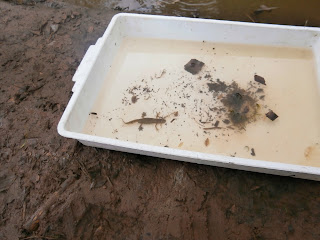
Most excitingly, we found a pair of breeding palmate newts. Male palmate newts can be identified by their large, black, webbed feet.They are darker in colour than the females who tend to be a more olive-green colour. Newts are amphibians and they enter the pond in the Spring to mate. The males swim around in an elaborate dance to attract the females who wrap each of their eggs individually in vegetation around the pond. At the end of the summer, adult newts will leave the pond and find a suitable home under some stones or logs perhaps,feeding off small invertebrates such as beetles. We were very surprised and pleased to discover them living in the pond at Badock's Wood nature reserve.
Pair of palmate newts
Male palmate newt
In addition to the fish, newts, Greater water boatman and pond skaters we found some tadpoles, diving beetles, great pond snails and water fleas so there was life in the pond after all! One of the main problems in this pond is the lack of plants and the muddy water. This is quite possibly due to dogs running in and out of the pond and stirring up the sediment - the lack of light reaching into the water impacts on the ability of the plants to grow. The students are now being very proactive about this and the school is running a poster competition to let people in the wider community know why it is important to protect this potentially great habitat. So fingers crossed, this time next year it could be a different story.

After the pond dipping we went down to the River Trym which flows through the nature reserve. Using this as a comparison to the pond we discovered that it was much more abundant in species. Biological indicators such as freshwater shrimps and mayfly larvae also suggested that it was a pretty healthy habitat too.With the newly informed wildlife explorers from Badock's Wood primary school on the case I feel pretty confident that the nature reserve will continue to go from strength to strength.
Stream dipping in the River Trym