Friday, 16 December 2011

A little taste of India in Southmead

Recently I've been working on a project at Badock's Wood in Southmead to engage primary school children with their local nature reserve.The project is funded by the Airbus Corporate Foundation as part of their India Biodiversity project. This is an amazing project which sends Airbus staff to a small community in India, rich in biodiversity, to provide the villagers with a sustainable fuel source and income.By building cattle sheds and biogas chambers the Airbus team create a system that converts cow dung into methane gas that is piped directly into the villagers homes and used for cooking.

For two weeks during each visit Airbus staff from around the world, build cow sheds, dig huge holes and create 3 biogas systems in extreme heat and primative conditions.This is absolutely life changing for the village community, no more 3-4 hours a day collecting wood, no more health damaging smoke filled homes and an income generated from fertlizer and milk sales.

Last week Emma Mayo from Airbus came along to Badock's Wood primary school with me to tell the year 6 class about her experiences in Southern India. Prior to her visit the pupils wrote letters and took photos of their school  for Emma to take with her to show pupils in an Indian school. Emma brought lots of photos back to show the class, explaining the work she had been doing, how she had lived and the wildlife she had seen. She then presented a garland of coloured paper created by the children in India as a gift for their new English friends. Each Indian child had written their name and something about themselves on a piece of paper to create the garland.The pupils of Badock's Wood primary had lots of questions for Emma and were fascinated by the Indian way of life, particularly the fact that they had no Playstations or shoes and that the volunteers had to dig a hole for their toilet!

Wednesday, 14 December 2011

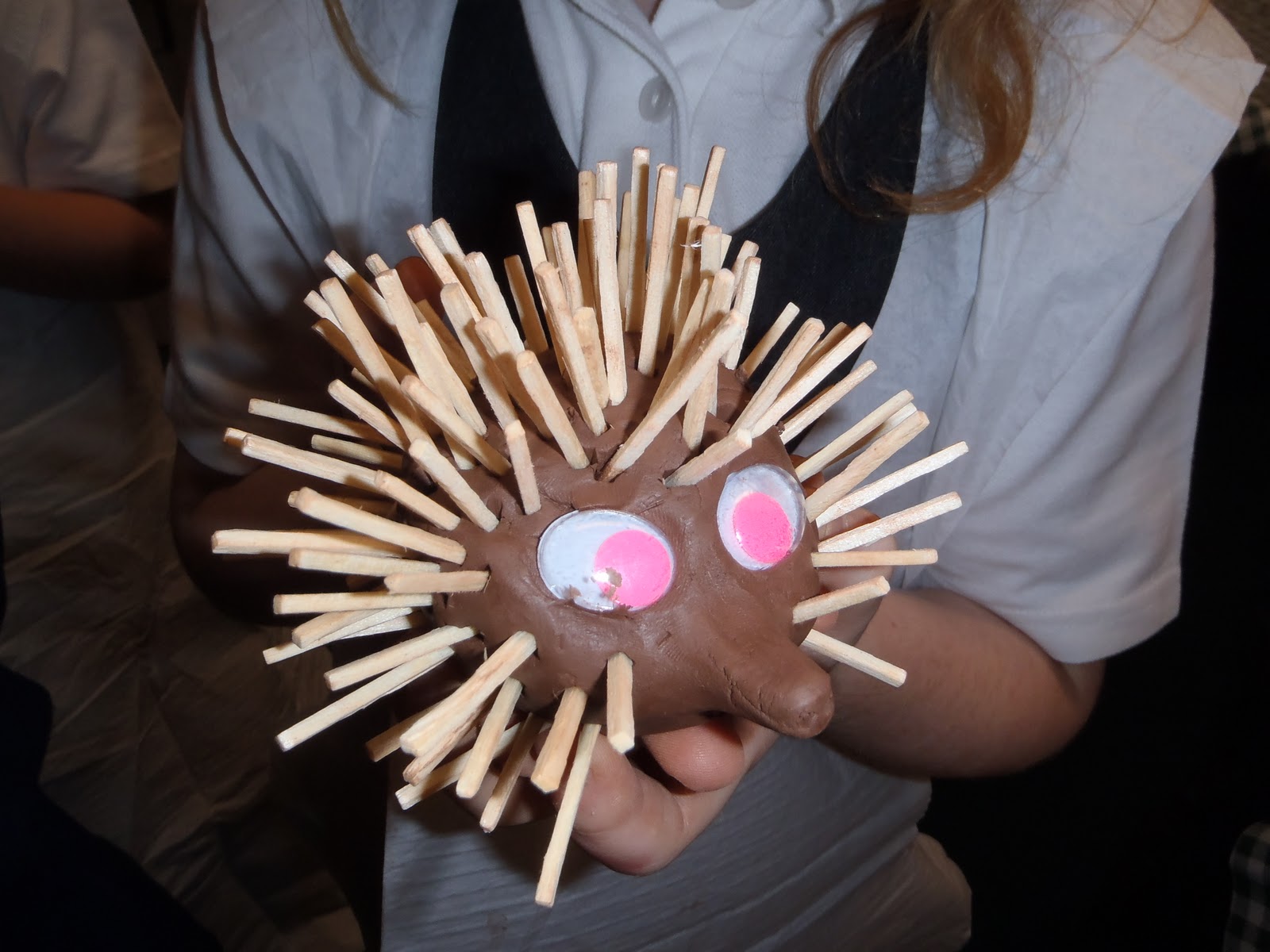
Make your own hedgehog!


After all the fun we've had making clay hedgehogs with children at South Gloucestershire primary schools in the last few weeks, we thought we'd share with our fellow readers how you can make one yourself! As well as having fun being creative, it's a great opportunity to learn some facts about our little spikey friends who are becoming endangered.


What you will need
  • Clay (air drying is the best)
  • Cocktail sticks snapped in half
  • Googley eyes (can be found in craft shops) or small stones also look great

How to make your clay hedgehog
  1. Get yourself a ball of clay, about the size of a satsuma.
  2. Roll the clay into a smooth ball.
  3. Squidge out some of the clay to make a nose. If you like you can prick little holes in the end of the nose for nostrils!
  4. If you're feeling particularly creative, you can give your hog some teeth or maybe even give it some feet with claws.
  5. When you're happy with the shape of your hedgehog you can put the eyes in place and give it spikes with lots of little cocktail sticks.
  6. Leave your hedgehog to air-dry overnight
.

Hedgehog facts
  • Hedgehogs have between 6000-7000 spikes.
  • Their eyesight is quite poor and so they depend on their strong sense of smell and hearing to find food and stay clear of predators.
  • Hedgehogs roll into a ball and point their spikes in all different directions to protect themselves against predators such as badgers and foxes.
  • Hedgehogs love eating slugs, snails, beatles caterpillars and worms.
  • A third of urban hedgehogs have disappeared in the last 20 years.

For more info on why hedgehogs numbers are on the decline and what you can do to help them, visit our Wild Hedgehogs website here. We're running a survey to help us get a clear picture of where hedgehogs are doing well and not so well, so if you see a hedgehog (dead or alive) then map your sighting here.

Wednesday, 7 December 2011

It's a Hog's Life


Ann and Claire had a great afternoon delivering an  'It's a  Hog's Life'  workshop to 90 children at Staple Hill Primary School yesterday! 
There was much excitement as we arrived and the children quickly realised that we had some hedgehog-themed fun in store! The biggest clue was Claire was dressed up as a hedgehog!


 The children learnt all about one of Britain's favourite mammals, what makes them such fascinating creatures and why hedgehogs are in trouble and need our help! Recent reports show that hedgehogs have decline by a quarter over the last 10 years.
You can find out more at http://www.wildhedgehogs.org.uk/
or see some video footage of these special creatures at
The pupils made some brilliant hedgehog creations out of clay and sticks, and had really thought about the long nose of the hedgehog and their many spikes! There were also some very interesting names too, including Spike, Spikes, Spiky, Brambleberry, Rose and Roger!
The children then provided excellent sound effects to 'The Adventures of Spike the Hedgehog' a story all about the perils of hedgehog life! The children were very inquisitive and had many hedgehog questions to ask us- but at the end of the day Claire and Ann decided to ask the questions and were very pleased at how much the pupils had learnt about our spiky friends! 
Thank you to staff and pupils at Staple Hill Primary School for such a fun afternoon!

Friday, 2 December 2011

The living landscape


With recent funding from the Mendip Hills AONB Sustainable Development Fund I am now developing an ambitious new project to encourage a wider appreciation of the local landscape, working primarily with Bishop Sutton Primary School in the Chew Valley. The Avon Wildlife Trust's Living Landscapes team are currently working to restore wildflower grasslands in the area and to support these efforts, I will be taking students out to study land on sites including Folly Farm and Burledge Hill, a Site of Special Scientific Interest. Through film-making and interviews with people in the local community students will investigate the importance of wildlife-friendly farming, sustainable landscapes and Avon's Wildflower Grassland project, enabling them to think about future implications of land use in the region and the protection of it for the future.Yesterday I went to explore the Chew Valley with Richie Smith, Living Landscapes officer at Avon Wildlife Trust, to see if it was possible for pupils from Bishop Sutton primary school to walk to our fantastic nature reserve at Folly Farm using public footpaths.


 Much to our delight it was a lovely walk, we crossed farmers fields, passed old orchards,bridges, ancient trees and beautiful views. We had to take a few diversions as some footpaths that were supposed to lead us across fields were non existent but it was easy enough to go round. Along the way we bumped into local resident, Vic Pritchard, who had lived in the area his whole life.He told us about the last notable lord, Henry Strachey, born 1863, who lived in Sutton Court. Strachey was an artist and  the son of Sir Edward Strachey. If you take a look in the Church of England parish church of St Nicholas and St Mary in Stowey you will see wall paintings by Henry Strachey from 1915, the story goes that he used the villagers of Stowey as models for his angels.


Vic also told us about the little stream that runs in front of the church and across his land. It is mentioned in the 1780 Collins History of Somerset book and was known as 'the petrifying waters' which were so pure that those who took from it never suffered from gall stones. A recent campaign by the local community to stop Stowey quarry from accepting waste such as asbestos was successful in temporarily halting proceedings. One of the concerns was that residue from potentially hazardous waste may enter the water courses, such as the 'petrifying waters', which have been pure and clean for hundreds of years.


Soon after chatting to Mr Pritchard in Stowey we came across an amazing gorge and mini waterfall, almost unseen until you got up really close. Not long after we arrived at our destination, Avon Wildlife Trust's 250 acre nature reserve Folly Farm.


We decided to head back to Bishop Sutton a different way, crossing the reserve and pausing at the top of Dowlings Wood to take in a spectacular view, before heading down across Stowey House Farm land and back to Bishop Sutton. This walk is going to be a great introduction for pupils to learn about their local landscape, see the impacts of farming and learn how they can help to create a prosperous, healthy environment to live in.
We will also be creating a teaching resource pack to accompany the Living Landscapes project and will provide training for teachers from surrounding schools, benefiting the whole community. Katie Geen, teacher at the Bishop Sutton primary school is right behind the project, explaining, 'We are very committed as a school to integrating biodiversity and children's appreciation of the local area into the life and curriculum of the school.'

Seeing young people excited about their own neighbourhood has given me the greatest pleasure, and I hope that they will continue to explore, discover and protect the diversity of wildlife on their doorstep.

Wednesday, 30 November 2011

Make your own Christmas Stars


With Christmas on its way, why not get creative and make some of your own decorations? It's a great activity to do with children and they can admire their creations through the Christmas holidays.


Whilst out and about in your local green space, collect twigs and take these home to start making a Christmas star! If you find any fur cones, bring them home as well as these look great decorated.


  How to make a Christmas Star:

1.  Select 5 of the straightest twigs (of similar thickness) and snap them to a similar length, depending on how big you want your star to be.


2.  Arrange the twigs in a star shape and glue into place at points where they are touching. Leave your star to dry overnight.

3.  When the glue is dry the following day, decorate your star however you like! Let your creativity fly! How about painting with glitter, covering with gold or silver tissue paper or wrapping with sparkley thread?


4.  When your star is finished, attach some thread and find a good place to hang it. You could even pop it on the top of your Christmas tree!

Wednesday, 16 November 2011

Dolebury Warren's Late Autumn Fungi

I had a fabulous day out at Dolebury Warren on monday identifying late autumn fungi with expert help from local ecologist and mycologist, Justin Smith.

What a day we had! There were carpets of fungi to be found of every colour imaginable!  If you're out and about in Dolebury this autumn then have a look through the pictures below to see what you could find.


We found some very impressive fairy rings of Clouded Agaric. The size of fairy rings can be used to determine how old they are since they move outwards with time.


I enjoyed some of the Wood Blewit for my dinner, fried in garlic and butter...mmmm.


There was a huge array of different wax cap species that we found in the grass land areas of the reserve. These are often brightly coloured species with slimy caps. The slimey surface of many fungi acts as a protective measure against slugs and snails which although slimey themselves, are not so fond of other slimey things!


The bright colours of many of the wax cap fungi may make them appear poisonous however, a number of them, including the Scarlet Hood are in fact edible.

The distinctive smell of some fungi help in their identification. Rosy Bonnet (Mycena rosea) smells of radish; Clitocybe fragrans smells of aniseed and Hygrocybe nitrata smells of bleach (nitrous...hence the name).


Here's a few interesting ones for you:

The milk cap Lactarius deterrimus exudes droplets of 'milk' when damaged. This specimen gave a bright orange milk which turned dark red within 10 minutes.
You need to have a keen eye to spot Earth tongues. If you look carefully, you might see a few of these poking up out of the grass like little elf ears...or tongues!
And finally, the infamous Fly Agaric (Amanita muscaria) which we found nestled under some trees. It is probably the easiest fungus to identify with its distinctive red cap with white warts, and is often depicted in fairy tales alongside elves and goblins. This  fungus gained its name from the medieval tradition of breaking it into milk and using it to stupefy flies  for easy swatting.
There are more fungi photos from the day on our flickr page.

Thanks to Justin Smith for sharing his knowledge on a fantastic fungi filled day at Dolebury Warren!

Monday, 14 November 2011

Create your own Leaf Mobile

This time of year is beautiful with all of the rich colours of the falling leaves. Why not try and capture a bit of that autumn beauty to bring indoors by making your very own leaf mobile! It's a great activity to get kids outdoors and trying to find as many leaves as they can with different shapes and colours.

What you will need:

Colourful leaves
A heavy book for pressing (yellow pages work well!)
Clear sticky back plastic / contact paper
Tree branch (found on the ground, not on a tree!)
Thread

How to make your leaf mobile:
  1. Collect fallen leaves - try and find as many different types and colours as you can.
  2. Press the leaves between the pages of a heavy book for a couple of days to flatten them (the Yellow Pages work well!).
  3. For each leaf, cut two squares of sticky back plastic about an inch wider than your leaf.
  4. Peel the backing off one of the squares, lay it down sticky side up and place your leaf in the centre. Peel the backing of the second square and carefully place it on top.
  5. Punch a hole in the plastic above the leaf (at the stem end).
  6. Carefully trim the plastic around the leaf, making sure to leave a small border.
  7. Hang the leaves from a branch using thread and find a suitable place to hang your mobile. How about suspending it from a curtain pole?
  8. Now you can enjoy autumn all year round!
Have a go at identifying what tree your leaves have come from. Here's a leaf identification guide to give you a hand.