Friday, 19 July 2013

Avon Wildlife Safari Day 1 - Visit Feed Bristol

Do you know your carrots from your cabbages? Any idea how to encourage bees to your garden to help pollinate your food crops? Have you seen a giant badger?

If the answer to any of these is 'no' then come down to our amazing Feed Bristol project on Frenchay Park Road in Stapleton, Bristol at 2pm on Saturday 20th July for a guided tour.
Marvel at the sunburst garden, go for a woodland walk, be amazed by the agility of the dragonflies flying around the wildlife pond and get some inspiration to take home. 

Food growing definitely doesn't have to be boring, this 8 acre site is full of wildlife that helps to keep nature in balance and encourages healthy plants and delicious food to grow. From the bountiful birds who feed on the garden 'pests' to the rich, healthy soil full of worms that provides nutrients for the plants to grow, the is a great example of growing food in a wildlife friendly way. So banish those chemicals to the shed and explore a different way of gardening, enjoy the natural world and take a step out of city life for an hour or so. 


For more information on developing a wildlife garden click here.


Friday, 24 May 2013

Nature is full of surprises...

Over the last two years I've been working with local schools in Southmead, Bristol, taking students on visits to the local nature reserve, Badock's Wood. Throughout the seasons students have explored the woodlands, wildflower meadows and hedgerows discovering an abundance of wildlife living in their neighbourhood.

 This project has been kindly supported by the Airbus Corporate Foundation to engage young people with the biodiversity in their area and as part of this project a new wildlife pond was created last year. Unfortunately, the pond suffered a fair bit of vandalism as soon as it was created, with benches being pulled out of the ground, plants ripped up and rubbish thrown in the water. Nevertheless, students from surrounding schools have been learning about freshwater life and went to look at the pond at every opportunity.

Last week was the first opportunity the pupils had to properly explore the pond, so we set off with nets, trays, identification keys, bug jars and a belly full of enthusiasm. Having visited the site a few days previously I was a little skeptical as to what we would find.The pond was brown with mud, there were no plants and I could see that someone had already added fish in the water which is never good news if you are looking to create a biodiverse pond as they devour the invertebrates, tadpoles, and anything else they can find.

After a health and safety briefing and a quick chat about how to use the equipment, students eagerly started to explore. Working in groups they took turns to take samples from the pond, emptying their findings into trays so that they could identify the species.

One of the first species to be found was a Greater Water boatmen. These strong swimmers swim on their back using their strong legs, which are covered in tiny hairs, to propel themselves through the water. All aquatic bugs lack gills and therefore have to come to the water’s surface to breathe air. However, Water boatmen have a clever trick that allows them to remain under water for longer. They collect air as a bubble on their body or under their wings; this allows them to breathe when underwater. When we looked carefully, using a bug jar full of water, we could see the little silver bubble at the end of it's abdomen as it dived down.
Common backswimmer - Mark Robinson - Mark Robinson

Male Water boatmen breed once a year and  use sound to attract females by rubbing their front legs against a ridge on their head to create a low chirping noise. Females lay their eggs on submerged plants, sticks, or rocks; allowing a brood of young Water boatman to hatch out straight into the water.


Pond skater - northeastwildlife.co.uk - northeastwildlife.co.uk
We also discovered pond skaters. These seemingly relaxed looking creatures, live on the surface of the water, spreading their long legs out and using the water tension to keep them afloat. But don't be fooled, really they are waiting for the chance to snack on dead or dying insects that have fallen into the water.They have sensitive hairs on their  bodies and legs to detect vibrations and ripples on the pond surface and using their sharp mouth parts they pierce the skin of their prey and then suck out their insides.
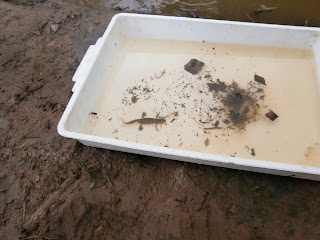
Most excitingly, we found a pair of breeding palmate newts. Male palmate newts can be identified by their large, black, webbed feet.They are darker in colour than the females who tend to be a more olive-green colour. Newts are amphibians and they enter the pond in the Spring to mate. The males swim around in an elaborate dance to attract the females who wrap each of their eggs individually in vegetation around the pond. At the end of the summer, adult newts will leave the pond and find a suitable home under some stones or logs perhaps,feeding off small invertebrates such as beetles. We were very surprised and pleased to discover them living in the pond at Badock's Wood nature reserve.
Pair of palmate newts
Male palmate newt
In addition to the fish, newts, Greater water boatman and pond skaters we found some tadpoles, diving beetles, great pond snails and water fleas so there was life in the pond after all! One of the main problems in this pond is the lack of plants and the muddy water. This is quite possibly due to dogs running in and out of the pond and stirring up the sediment - the lack of light reaching into the water impacts on the ability of the plants to grow. The students are now being very proactive about this and the school is running a poster competition to let people in the wider community know why it is important to protect this potentially great habitat. So fingers crossed, this time next year it could be a different story.

After the pond dipping we went down to the River Trym which flows through the nature reserve. Using this as a comparison to the pond we discovered that it was much more abundant in species. Biological indicators such as freshwater shrimps and mayfly larvae also suggested that it was a pretty healthy habitat too.With the newly informed wildlife explorers from Badock's Wood primary school on the case I feel pretty confident that the nature reserve will continue to go from strength to strength.
Stream dipping in the River Trym


Monday, 29 April 2013

Sunlight, camera, action ......Wild Schools Film Challenge launched

The Learning team are proud to announce that the Wild Schools Film Challenge is ready for schools to book their free kit boxes.

Wild Schools Film Challenge encourages young people to get outdoors and engage with nature by making their own wildlife film in their school grounds. 
Created with the support of the community outreach and education project team from Rolls Royce, Wild Schools Film Challenge is designed to be a fun and inspiring way to learn in the natural environment and support students' classroom learning. 
All of the equipment you need to create your films are available in our kit boxes, including 10 cameras, tripods, ID guides and bug hunting kit and voice recorders.  There are four kit boxes available for schools throughout the Avon area free of charge to borrow.

Our website is packed full of how to guides, lesson plans and resources as well as links to completed films by students.

Many thanks to Ashton Gate and Little Stoke Primary students for all their help over the last year in trialing equipment and the project so that other schools can enjoy doing it.  Charlotte Thomas, year 4 teacher from Ashton Gate Primary School, commented that "students have really loved the filming project and are still very enthusiastic about all the follow-on activities.  We have showcased our films to visitors coming in to school and a number of students have also made films at home using the skills they learnt from the Wild Schools Film Challenge.   A number of parents have commented on how much the children have enjoyed the activity and the whole class are generally more wildlife-conscious in their activities."  

Years 5 and 6 from Little Stoke Primary enjoyed the opportunity to challenge themselves to make a film and agreed that "it was a great way to get fresh air" and that they had found wildlife they never knew existed.  Aidan shared his class' experience: "It was a good learning experience for all of us, and if I had the chance I would do it all over again".


We were also on the BBC news recently who used the project as an example for learning outside the classroom and how it benefits learning and personal development.
If you would like to know more about our Film Challenge please contact schools@avonwildlifetrust.org.uk or 0117 0177270 option 6 or check out our website which includes introductory videos for teachers and students to explain Film Challenge in more detail.

Jo Morris
Learning Development Manager

Wednesday, 17 April 2013

Wild Schools live on BBC news with Little Stoke Primary

Bright and early on Friday morning, years 5 and 6 students from Little Stoke Primary School became TV stars appearing on BBC Breakfast news. 


Everyone involved even impressed the BBC studio so much during the first live segment that we ended up doing an extra two live segments along with two headlines during BBC 1 breakfast news show which has over 7 million viewers.

The BBC was reporting on research by Sue Waite from the University of Plymouth  on how learning outside of the classroom benefits children's learning when back in the classroom and they were looking for a school to demonstrate an outdoors project.

Thanks to a very enthusiastic Mr Trimble and his year 5 and 6 class the very next morning we set up our Wild Schools Film Challenge in the school grounds ready for the BBC film crew.  The Wild Schools Film Challenge has been piloted by Little Stoke students who  helped test all of the equipment and will be ready to launch in the next few weeks to all schools in Avon.  

Students got the chance to show their film making skills once again live on TV and were true professionals giving some fantastic answers to BBC news reporter John Macguire about why they enjoyed learning outside the classroom.  In case you missed it you can view the last segment here 
 Well done to everyone involved and a special thank you to Mr Trimble and Mr Howes and the students of Little Stoke Primary School for getting up extra early and doing such a fantastic job. We can't wait to see your final films of your school grounds.

Jo Morris

Friday, 22 March 2013

It's World Water Day!


So let's celebrate with this final blog entry about the Trout and About project from 5P at Ashton Gate primary school.

Monday 18 March 2013
Today we went to Blagdon lake and fed 18,000 fish. Then we went on a nature trail through the woods and saw the lake overflow in action. After that we went to Chew Valley lake and walked on a very muddy path to release our trout at the stage of fry. Also we got sticky bits of card and made pictures out of small plants. Some fish had no egg yolk left when we released them. Everyone misses the trout a lot already.


The field trips have been a great ending to a fabulous project. Students have had the chance to see how their fish will grow and develop. They've got muddy and wet, visited small rivers and big lakes, learnt about where their water comes from and how the lakes support a wide range of wildlife. 

Thanks also to Bristol  Water who have funded the whole project, providing the transport and tuition costs, fish husbandry expertise and tanks, which has enabled the project to be truly inclusive. 


Finally,thanks to all the students, your blog entries have been really interesting. I've loved working on this project and glad that you have enjoyed it too. Don't forget to look for the MSC tick when buying fish to make sure it's sustainable and look after your school pond by providing lots of nice plants and keeping it litter free.

Happy World Water Day!

Tuesday, 19 March 2013

Free the fish!

Last week many of the classes involved in the Trout and About project visited Blagdon and Chew Valley lakes and set their fish free.At Blagdon lake students had the opportunity to feed some really big fish and see some fry that were slightly older than the fish they had raised in school.
Feeding the fish at Blagdon visitors centre

Looking at the fry


Releasing the trout at Chew Valley Lake
Here's an extract from class 5B at Ashton gate primary school


Goodbye Trout!

On Monday we went to release our trout (fry) into a real water habitat.
We all went on mini buses to get to Blagdon, where the Bristol Water Company set up all their machinery. They showed us many different things, including lot’s of tiny little trout, massive trout feeding and powerful machines for purifying water. After this, we got back on the mini buses and set off to Chew Valley Lake, where we would release the trout. We were each given sticky bits of paper to stick natural resources on to make a picture. After that, we set of on the long journey to the lake. When we got there we were releasing around 8 fry in partners into the further upstream lake. We waved them off and wished them luck in the big wide world! Then we walked to bird hide where we given binoculars in pairs to spot some beautiful nature. Although it was freezing, we were all had a lot of fun!

So far I think we must of released over 500 trout! The last field trip is tomorrow with Parson Street primary. I'm going to release my fry from the Avon Wildlife Trust office too.

Sunday, 10 March 2013

End of week 3 of #troutandabout

Exciting times.....all the eggs have hatched and my student parents are doing a fine job. The alevins are wriggling around, and as far as I know, Jane's Pond is still alive at Ashton Gate primary and Alevin and the fishmunks are doing swimmingly at St Barnabus.

Hatched alevins at Ashton Gate
This week pupils have been learning about the Marine Stewardship Council and discovering more sustainable ways of fishing and watching their own  fish change and grow as they start to explore the tank.They also discovered that their trips next week will take them to the reservoirs of Chew Valley where they will learn about the different habitats around the lake and compare the freshwater habitat to the one they studied near to their school. These are owned by Bristol Water and supply water to homes, schools and businesses in Bristol. 

Barni from Ashton Gate primary school  has sent an update for the blog.

Thursday 7 March 2013
Julie set the trout out of the cage into the fish tank, sadly a few will never be able to swim because they didn't make it. There's been a few that have tried to swim up but they need to absorb their egg sacks before they can properly swim about.
The trout are huddled together to not be seen. It looks like we will have a few swimmers in a few days.

Two weeks to go......we're hoping to make a film of the project so watch this space to see how the trout and the pupils get on.